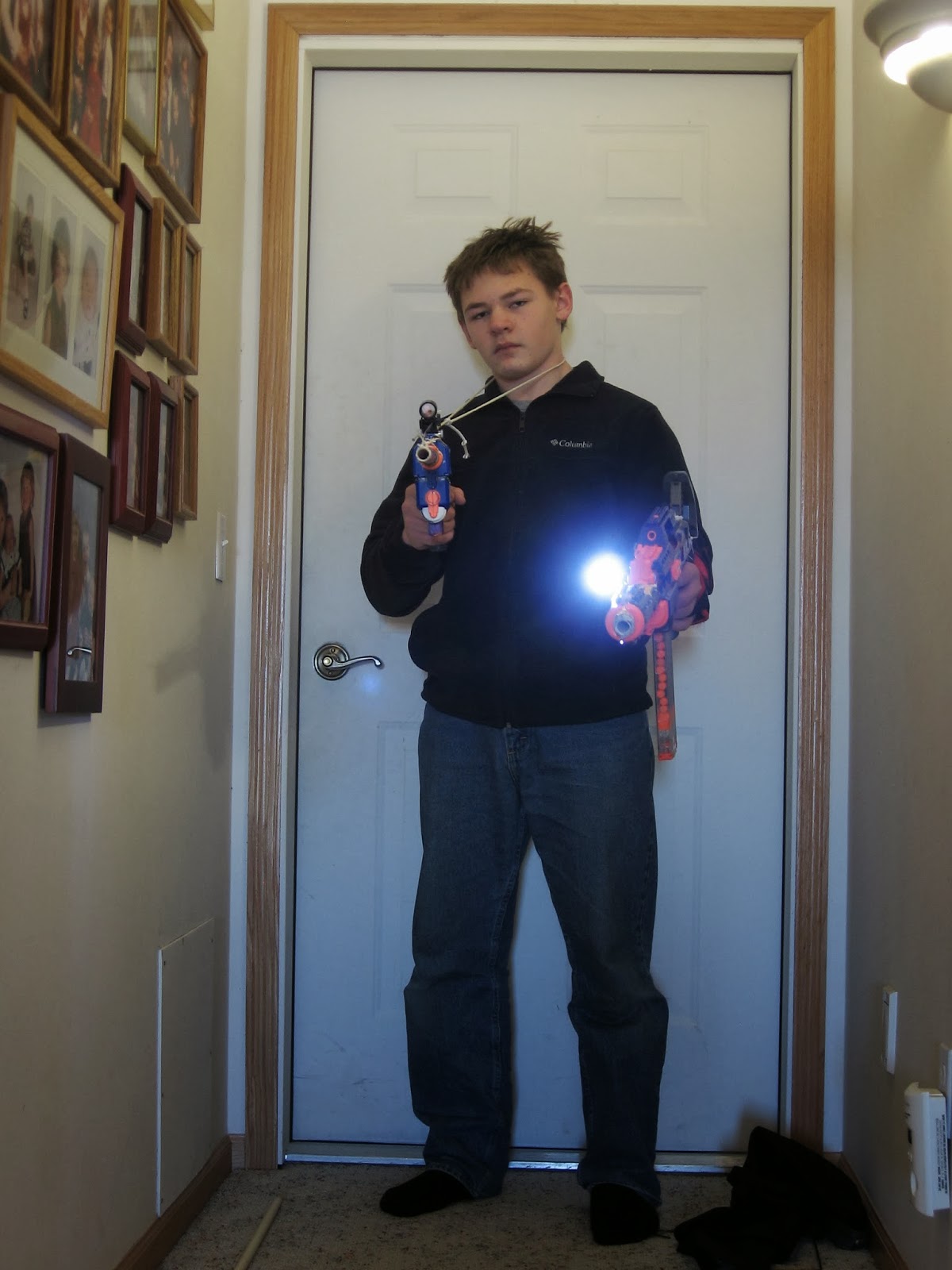
Tomorrow's blaster technology.

Monday, October 13, 2014

A New Project: "Winter Soldier"

So, I finally watched Winter Soldier. And I loved it. Although the fighting styles were limited to just guns, grenades, and small knives, with the exception of the shield. But it inspired me to develop an idea I got when I first heard the term "Winter Soldier."

I'm starting a new project, and I'm probably alone in my work, but any collaboration would be greatly appreciated. Odds are, I won't have any help anyway. But it's worth a shot, right?

On to the new idea. What if there was a new class of blaster and competition, one where people were required to wear clothing that leaves no skin exposed? It would only be natural, as these battles would only take place in the wintertime. With gear covering everything, darts can hit a lot harder, and therefore fly faster, and instantly the game becomes exponentially more intense.

Winter Soldier class blasters would fire weighted darts, flying at up to 200 fps. The darts would be very rigid in structure, having a hard enamel on the surface of the foam, except for about half an inch at the tail, which would seal in 1/2" PVC, PETG, or brass.

Getting the blasters up to that power level will take some heavy engineering and application. There are a number of approaches:

  • Flywheel
    • electric
      • brushed
      • brushless
    • hydraulic impeller
      • liquid nitrogen
      • dry ice
      • compressed air
      • water
      • other hydraulic fluid
  • Plunger
    • PVC breech
    • PETG/Brass breech
      • favorable technology, as it has been developed very well by the NIC. Thanks, guys. The world owes you one.
    • Compression-ignition charge
      • Diesel engines don't need spark plugs because the fuel ignites by the heat from the sudden compression in the cylinder. This concept could also be applied to a plunger firing darts.
      • In model rockets, a small charge fires into the fuselage of the rocket from the top of the engine, popping out a streamer or parachute, called a recovery system. To keep the recovery material from being damaged by the heat from the charge, flame-retardant paper is wadded up and put between the charge and recovery system.
      • The entire plunger and breech would have to be metal, and the dart foam would have to have flame retardant compounds in it. 
  • Triggered Blast Valve
    • No longer in any blaster on the shelves, this is a very high-quality piece of technology. This type of valve is found in some drink dispensers and in BuzzBee rocket launchers. I will pay a fortune for a couple of those blasters.
      • Now, in all the BuzzBee Extreme blasters, there is a very similar device, although the main release valve is actuated by releasing the air from a secondary chamber. With the pressure limit safety removed and the chamber pressure higher, the valve in the secondary chamber requires too much force to actuate, and the shell can't withstand that force. The blaster has to be disassembled in order to release the chamber pressure.
    • The chamber can be charged by a few methods:
      • hand pump
      • dry ice
      • liquid nitrogen
      • science-fair-style vinegar and baking soda (not really though, that doesn't work)
      • carbonated drink (you can get a shot or two out of an 8oz bottle of soda, but the pressure is pretty weak)


The Pinpoint worked by means of a triggered blast valve. It was made out of a BuzzBee Berserker. These days, those are hard to get my hands on. Hydraulic flywheels could be very effective, but those things still have to spin up to some extremely lofty speeds.

The Winter Soldier idea is defined by the changes to the rules and safety limits. Normally, you are "out" if you are touched by a soft Nerf object or other brand of dart and you do not catch it. This rule is made to be compatible with Nerf sports items. In Winter Soldier competition, the rule would not include the catching bit, and the sports items would not be included. The other new rule is that

This could turn out to be very exhilarating and intense. Too bad it won't work in Singapore or Brisbane. It does require cold weather. But any support on developing these high-power blasters, or information about existing developments in this area.

Comments are greatly appreciated :)

N-Strike Epic

Wednesday, July 23, 2014

Introducing DLSTS

The story starts with me buying a Centurion. I looked at the chart on the box, and noticed how biased it was. Then, I noticed a performance claim on a cleaning solution, and it also had an asterisk by it. But instead of saying, "actual results may vary," it said, "tested according to ASTM-[I forgot the numbers.]" And I thought, what if there were testing standards for dart blasters? I figured it was worth a shot, so I started work on what I called the Dart Launcher Standards of Testing and Safety, or DLSTS.

 It's quite an endeavor, I know, but it could turn out to be quite useful in the future. Even if companies don't use it, bloggers still can. And they won't overestimate or underestimate, because they can completely not estimate.

After I had worked for a few hours on it, I realized that this would be impossible to do all by myself. So, I'm asking for suggestions, ideas, whatever you might think of that could be added or changed.
DLSTS Page

Saturday, July 12, 2014

Getting back up to speed

So, it's been a while since I last made a blog post. First things first, the pinpoint simply doesn't exist anymore. A leak that sprung a few months ago just became too much and the blaster ceased to work, so I scrapped it.
In happier news, my Retaliator mods are going quite well. They're not anything really new, though.

On to what I have invented: the straw-core dart. A straw is inserted into the dart and held in place by a tad of rubber cement. This keeps the dart from warping and makes it fly mostly straight.
Another version of the straw-core had only a small ring of foam and a head on a straw piece. This dart flew extremely straight and was very light, but only went 40 feet or so after being fired above 100 fps. It had very little momentum and a lot of drag. 

Also, I miniaturized my Rapidstrike, and I redid the battery mounting. The result is an Uzi-like blaster with the power of a 12 volt rapidstrike... Well, it is a 12 volt rapidstrike. But with a lithium battery, it is capable of firing without accelerating first. I did this many times when I was ambushed by my brother, and I actually won a few of those rounds. 
It also has a small barrel that is easily removed. The barrel gives it significant accuracy, but without the barrel it just fires a general swarm of darts.

And lastly, I still need to decide between getting a Centurion for its immense plunger, or getting a rampage for its 25-dart clip. Any help deciding would be wonderful. Thank you. :)

Monday, February 10, 2014

K.I.S.S.

In lieu of Tactical Tag's threefold article, "the edge of innovation," I have created a response, and I stumbled upon another idea .
These recent weeks in the NIC have had an air of "let's find new technology." So Tactical Tag created a whole new blaster concept that was the culmination of all the NIC-created blaster technology. It seems to perform like an overpowered Rapidstrike. It just so happens that last weekend I finally did the lithium upgrade on my Rapidstrike that has been waiting for a long time- it boasts 60-70 fps and about 6 shots per second. 

Okay, it's been several days since I wrote on this article. Back to it. About the title, KISS stands for keep it simple, shithead. (Pardon my French.) This was my response to the blaster concept that was recently introduced. I'll just list some pros and cons: 

Pros:
Powerful
Fast release by the butterfly valve
Repeating/ internal power source
Compact

Cons:
Noisy compressor
Heavy all over
Distance between the breech and pump handle
Slow reload
Clunky systems

Now on to the new tech presented here- let's just take a look.
Brass breech
Butterfly valve
Compressor? Not too practical...

I just wanted to say that yes, we can innovate, but innovation is not at all an easy thing to accomplish. It takes a lot of time and money, and hasbro isn't going to spare that.

Thursday, January 23, 2014

One-Handers and Behemoths

So recently I've taken the liberty of going big. It certainly makes blasters look more menacing, and with my Rapidstrike, the flywheels make an intimidating sound anyway.

Pinpoint
I have been working on the Pinpoint for over two years now, and recently it has gone through several makeovers. I extended the barrel, added a piece of a Recon to act as a small fragment of a shell, and added a sorely needed bipod. There have been many projects called "nerf sniper" or something of the sort, but they mainly focus on outward appearance. The Pinpoint is engineered almost entirely for performance. It can reach muzzle velocities of over 130 feet per second, and it has unmatched accuracy and stability.


Rapidstrike (Cobra Mk III)
Yes, I did have to try 3 times to make a one-hand automatic blaster that worked properly. It really didn't go well the first two times, with darts melting and motors shaking themselves to death and many other dramatic failures. But now it works, it is remarkably comfortable, it only uses one hand, and it's HUGE.


This blaster and the pinpoint both adapt a lot of technology from archery. The arm cuff on the Cobra III is similar to arm guards used in archery to protect the forearm from the bowstring. This blaster is actually quite heavy, but I can still support its weight with my arm fully extended.

Kingfisher
The Kingfisher, my Retaliator mod, is now a one-hander. It reloads by means of a neck strap/cord, attached to the sliding primer on the top. I also added a string reaching from the end of the handle to the end of the stock (because it looks nice and makes it look a lot bigger). Je vous presentez le Kingfisher.


About what I said earlier in the way of hugeness...


As you can see, my Rapidstrike is big, heavy, and intimidating. It's even more intimidating with a 6-dart clip in it. It has some nice performance, just an accuracy upgrade from stock form, but not much.

Monday, January 20, 2014

The Big Picture of Development

The development of dart blasters can be compared to the development of firearms. And that's exactly what I'm doing in this article.

The earliest known weapons mankind used were rocks thrown at targets. The Nerf counterpart would be the original Nerf ball, made from the invention that started it all - Non-Expanding Recreational Foam.

Then it goes to Chinese hand cannons, and Nerf making a "gun" to shoot the harmless foam balls.
Chinese hand cannon (Wikipedia)
In Europe, firearms developed into the first smooth-bore personal firearm, and then muskets, which lines up with the invention of darts.

Then we reach the point of flintlock rifles, and here Nerf makes a jump and skips a step.

Europe then develops breech-loading technology, and Nerf comes out with the Sawtooth, a 5-shot clip-fed blaster.
Sawtooth (Nerf Wiki, AFoN)
This also covers the invention of repeating firearms, starting with revolver pistols (comparable to the Maverick REV-6).

Then, finally, we get to the age of automatic firearms. The first automatic blaster was the Stampede, not  breech-loading, similar to early gatling guns. Then with the invention of breech-loading automatics, we have the Maxim gun, firing 600 rounds per minute, but requiring a team of 10 to operate. For blasters,
we come to the well-known Vulcan, which only requires 1 person, but it would be nice to have two.

Overall, the largest difference between these two developmental timelines is the scale of them. Nerf products first came out in 1970 with the Nerf ball. Humans started throwing rocks before they became sentient. Then we get to the first Nerf blasters, debuting 18 years later, and that compares to the gap from pre-sentience to the Yuan dynasty, say, 18 million years or so. At every step of the way, Nerf moves far faster. Currently, Nerf hasn't yet developed an automatic breech-loading rifle. 15 years from the first nerf blaster, we have advanced as far as firearms did over a span of about 1500 years. 

This summer, I plan to get my hands on a newer Vulcan and modify it into an automatic sniper. But that means another article entirely.

Monday, December 30, 2013

Happy New Year to the NIC

Happy New Year, everyone! In this giant article I'll be doing my best to catch up on all the stuff I missed during my long period of "blog silence," for lack of a better term. I set up a sort of "display" of all the topics in this article:


First, I will debut 3 new mods: The Kingfisher, a BuzzBee Range Master Extreme, and a HammerHead.

The Kingfisher is mostly a Retaliator with a bigger spring. It has a different barrel, a carbon fiber reinforced old Recon stock, and my handy virtual-image sight. It is a quiet, accurate blaster for shorter-range shots.


The HammerHead mods I did are rather simple. First, I replaced the recoil spring with a rubber band. I often do this to make blasters quieter. With TR blasters, however, quietness will never be their strong suit. The more important mod is that I lubricated the mechanisms with my own LubriKing concoction, a water-based light lubricant made for plastic parts that would normally rub and cause friction.


The LubriKing formula is simple: 2:1 of water and soap, and then add chalk dust. This forms soap micelles around the particles of chalk, making microscopic rollers that stay between parts and reduce friction. The result is a much faster TR blaster. however, the clip should never be lubricated, since the forward ring hook has to return to its original position before the ring falls into place, otherwise the blaster misfires and/or jams.

My brother bought me a Range Master Extreme for Christmas. It has a pneumatic reservoir and a pump, as opposed to the usual plunger piston. It works as a bolt-action rifle, with the bolt attached to the assembly of the entire firing mechanism. In this setup, the piston stays fixed while the cylinder, reservoir, valve and breech slide with the bolt handle.
I found it impossible to remove the AR from the breech. The AR in this blaster actually helps accelerate the dart in the little space that it has.


The power mod was simple enough: cover the limiter valve hole with a piece of tape. This allows the blaster to charge up 7 pumps, as opposed to the previous 4-5 pumps.
I also added a functioning optical scope to replace the plastic dummy sight that it came with.
In normal conditions, the blaster ranks in my high-power class with a muzzle velocity of about 85 ft/second. At 0°F, however, muzzle velocities were around 55 ft/second.

This leads right into the topic of the Earthglider, which I have mentioned before. It is basically a remote-controlled car with a shortened Nerf sword on the front. It has the capability to outrun a person in many situations, but I made it specially for winter. It will not run on snow that is too powdery, since it digs itself in and then must be retrieved.  Its soft tires spread its weight out more than a person in boots, so in most situations, it has the key advantage of being able to traverse on the snow, not through the snow.


I also pulled out my two other snipe blasters to compare to my new Extreme blaster.
As for speed, the new sniper falls short of the Pinpoint and the Blowsword, a mere 85 fps against 105 and 115. Its accuracy, however, is paramount. The Extreme darts are made with harder foam and much higher consistency. 


Have a happy 2014! :)

Monday, October 28, 2013

The Earthglider

I have had an idea for a unique strategy for a Nerf war for quite some time, and that idea is a remote-controlled car. I just did a unit conversion of its top speed, and it can reach up to 35 ft/second. That's as fast as the entire Elite lineup shoots darts. The Earthglider is also more agile than a person, which is insanely good. It simply is a remote control car with a shortened nerf sword on the front.
An overview of the Earthglider, showing its overall shape.
The Earthglider's ribbed front tires are critical to its agility.
 This is a 1/10th scale remote-controlled car that is stronger than both of my arms put together. It is entirely electric-powered, but I don't have a battery for it at the moment. It has a 50-gram steering servo, which gives it most of its agility. The car doesn't even have brakes, but it has about 10 square inches of tire in contact with the ground, giving it a huge amount of rolling friction. From top speed, it still stops in about 50 feet on a smooth surface. I am looking forward to next spring, when I can actually start using this. :)

It's hard to see, but if you look closely, you can see the steering system inside that little cove in the front.
The Earthglider actually is as fast as a dart fired from a stock blaster. I was actually quite surprised when I discovered this. On my front lawn, it rides the bumps like a speedboat, since it just rides on the top of each bump and then hops over to the next one. Its suspension is actually extremely well-tuned, allowing it to chase down a person on most types of ground.
This picture shows the Earthglder's motor and knobbed rear tread.
Questions and comments will be warmly welcomed! :)

~N-Strike Epic

Saturday, October 26, 2013

Rapidstrike Review!

This is going to be an official review of the Rapidstrike. I will be including a general review, some reverse engineering, tactical advice and modding advice.


General Review

The Rapidstrike is an automatic flywheel-type blaster. The flywheels have ben optimized for maximum performance and minimum damage to the darts, making power mods pointless. It is already rather powerful, anyway. It has an accuracy of about a 6 foot radius at 30 feet in stock form, giving it a substantial, but not very useful, range. At 15 feet it gets about a 2 foot radius.
Unmodified, this blaster is most useful as a dogfight/swarm blaster, but its weight and bulkiness make the Rampage significantly better for this task. Even for $40 at Target, this blaster is not quite worth the money.

The best advice I can give is that it's best if you use the jam door to stop the flywheels instead of letting them just coast. Holding down the acceleration trigger with the jam door open will create a closed circuit between the motor terminals, which quickly and forcefully stops the flywheels.


Reverse Engineering

This is a photo of the internals of the Rapidstrike from Coop772:

Safety Switches and Lockouts:
1. Forward Clip Sensor: No power flows when this is released.
2. Rear Clip Sensor: This is a mechanical lockout that keeps the launch trigger from being pulled.
3. Jam Door Switch: This switch is depressed when the jam door is open or partially open. It cuts off power to the flywheels, and also stops them when the door is opened.
4: Trigger-to-Trigger lockout: This is a mechanical lockout that keeps the launch trigger from being pulled when the acceleration trigger is not pressed.
Triggers:
1. Acceleration trigger: This cuts off all electrical connection from the flywheels when it is not pressed.
2. Launch trigger: Gives the dart advance system the command to cycle continuously. 

More on the dart advance system:
The dart advance system is comprised of a motor, a gearbox, a crank, a shaft, and a switch. The switch is depressed once each cycle when the shaft is fully retracted, cutting power to the motor. The switch is wired in parallel with the launch trigger, so when the launch trigger is pulled, the recetion switch does not stop the cycle of the shaft. If the clip is removed mid-cycle, the forward clip sensor cuts all power and the cycle remains uncompleted until the forward clip sensor is depressed.


Modding Advice

The rapidstrike uses C-type batteries for a reason. It has the rating stated on the side of the blaster as 6V DC, 30W. The C batteries have lower internal resistance, and can uphold the high current demand of the blaster without too much voltage sag. I used a 9V rectangular battery for a while, but it made the blaster significantly less powerful. The only significant battery upgrade would be to install a large 2-cell lithium polymer battery (7.4V) with equivalent capacity, but this would be expensive and would only make the blaster lighter.

As I said earlier, the Rapidstrike does not get any benefit from power upgrades. This is because it has already been optimized in the tradeoff between lack of power and dart damage.


So, the only mod I did was an accuracy upgrade, which involved moving the rifled barrel section forward so it could do its job. The rifling actually does work, but only when the dart comes in contact with the side of the barrel. I moved the barrel forward, leaving an open space for the dart to traverse unsupported. The darts would occasionally prematurely veer off-course, resulting in a massive pileup where the barrel used to be. To remedy this, I added about 3 inches of barrel tubing from my old Recon, and that solved the problem. Since the barrel is now farther forward, the darts come in contact with its inside surface, doubling the blaster's accuracy.

Also, I have a personal preference to have an open area of casing instead of a closable jam door, so I removed the jam door.

I added the handle from my Retaliator to the lower rail to help support the hulking mass of plastic and metal that the Rapidstrike is, and I also added my 9-LED floodlight on the left side rail. It seems to be quite effective in blinding an opponent in low-light conditions.

I plan to make a custom high-capacity clip for the Rapidstrike, since it empties its current one so quickly. I have encountered some problems, but I hope I can solve them.

Feel free to comment any questions you may have, and I will reply as soon as I can.
Thank you! ~N-Strike Epic

Monday, October 21, 2013

Epic New Blasters and Breaking the Flywheel Barrier

So, all along, my mission has ben to make blasters that outperform all current stock Nerf blasters. I have succeeded in that quite effectively, and my Firestrike (which I'll probably end up calling "ÃŽle de France") is the start of a new mission for me. Now, I am working to get every ounce of performance possible out of dart blasters. One rule: they can't be capable of injury.

So, I have decided to make an arsenal of blasters with muzzle velocities upward of 85 ft/second.
So far, it's just the Firestrike, Pinpoint, and, surprisingly, the Blowsword.

Firestrike
Pinpoint
Blowsword

Also, one project that has been waiting for a long time, since its a bit pricey, is the Earthglider. I built a remote control car that has the agility of a human. it doesn't even get to 22 mph, but it can get up to 15 mph in under 2 seconds. So I put a shortened nerf sword on it, and thats pretty much it. One problem: I need a new battery, since my current one didn't last all that long doing those repeated power surges that are required during acceleration. It's a 500 watt system, and that battery just didn't quite hold out. Some ozone formed inside its cells, and that raised its internal resistance, which lowers its performance even further. I'll probably jack it up to an 800 watt system when I get a new battery for it. This is not a cheep thing to do, the right battery is around $60.

Also, I got myself a Retaliator and a Rapidstrike. The Retaliator has the AR removed and a heavier spring, as well as a different barrel extension. I really got it for the stock barrel, which I put on the Pinpoint. That really pays off.
My rapidstrike.

The Rapidstrike has a 9V upgrade already, and that really didn't do all that much. Eventually, I'm thinking of adding a secondary flywheel set that re-accelerates the darts. I'm not 100% sure if it would work, but I'd say it's worth a shot, at least 90% sure. This would probably just involve getting another Stryfe and extracting the flywheels. Since I want to double the kinetic energy of the dart, that requires some physics calculations.
Let:
S = Speed
Ke =  Kinetic Energy
V = Voltage to Motor
I = Current
P = Power
R = Resistance

First, the two statements that are always true in an electric circuit:
P=VI
V=IR
From these,
P=VV/R
And Newton's Second Law:
Ke=0.5SS
An approximation about the motor:
S is proportional to R

So, we can say:
P is proportional to VV/S

Wait... oh yeah, this one makes it all really quick:
The square of the speed is proportional to the voltage.

(That one I came up with while working on the Earthglider.)

So, adding Newton's second law of motion back in, we can say that:
The voltage is proportional to the square of the speed, which is proportional to the kinetic energy present.
So, since V is proportional to Ke, if I want to double Ke, I should double V.

For those who skipped all that, the second flywheels run on 18 volts.

I just published my response to the technical problems (namely, friction heat melting dart foam) that are the reason that flywheel blasters are so limited in performance.
This is a pretty big breakthrough. The NIC needs to start developing this technology of multiple flywheel sets. It really is going to pay off... seriously, people, get on this. Flywheel blasters and their semi-auto/automatic abilities just need a performance boost. So who's with me?


Sunday, October 6, 2013

Pistol Mania!

I haven't had as much time on my hands these days, with school and all that going on. But i still have weekends mostly free, and so I ride bikes and do Nerf mods. At least I have that much of a life.

On to today's topic: Pistol Mania! From left to right: RADS12, Vortex Proton, Firestrike, and Hunter.


And I didn't even get the Kabam in the picture. But that one is basically small. Like as small as physics would allow. It really isn't much more than a Jolt on steroids.

Well, on to the RADS12: It has 12 shots on the front, as you can see, and 4 sets of 3 barrels. It has a lot of things just for show when it comes to reloading, but it can still reload faster than the flywheel blasters. Who cares about automatic and semi-auto? I can reload my own blaster, thank you. It usually works better, too.

On to the Proton... I have been using it to test out the Vortex discs, and I have come to the conclusion that the XLRs are actually worse. Longer range, maybe, but they fly a lot like frisbee golf drivers. The standard discs fly much straighter. Discs in general are a real pain in the first place, since they're very sensitive to wind.

I'll go with the Hunter first: It is extremely accurate, and more powerful than a stock Firestrike, and it also holds more ammo. It is slightly bigger, however, but that really isn't a problem. In fact, the Hunter has space for two hands and a padded mini-stock on the back.

My Firestrike, however, sends the dart flying at 90 feet per second, and classifies itself with the high-power Nerf blasters. But, of course, I have already modified it heavily. It is not quite as accurate as the Hunter, but the Hunter clocks around 30 feet/second.
Who doesn't love a good Firestrike?
The Hunter, having fallen behind my other blasters, might be for sale sometime. But not yet. 

And to answer that pressing question about why the Firestrike was so good, in stock form it really isn't that good. The two darts on the front are very nice, and it is very fruitful to modify because of its massive cylinder and simple power transfer.

Vivé la Nerf!

Tuesday, September 24, 2013

The Firestrike: How in the world is it so amazing?

So, the Firestrike. What makes it different from all the other blasters in the Elite lineup? It has the same firing section, and no barrel extension, yet it is still very accurate and powerful.

Theory 1: Compact size due to a direct-plunger system.
The direct plunger of the Firestrike is by far the largest of its kind in the Elite lineup. The firing cylinder is far larger than that of the Jolt or Triad. It makes a very good pistol for situations that do not require much stealth, and it is in fact unique among the Elite lineup in this way.

Theory 2: Accuracy... How does it do that? Perhaps it has something to do with the longer pin inside the dart. I have noticed that this device keeps the dart straighter prior to firing. A slightly curved dart actually makes a huge difference when you don't have an extended barrel. This actually makes a lot of sense, since the Jolt and Triad lack this feature. I have found in my experiments, however, that a simple 1/2 inch diameter barrel long enough to hold the entire dart without anything sticking out the front is much more efficient in accomplishing this task.

So, the Firestrike is actually pretty good. Plenty of power, and extra accuracy makes it many Nerfer's favorite blaster.

Since my goal is to outdo all the Nerf blasters on the market, I had to make some sort of a response to this. And I will say that this blaster one-up has been by far the most difficult. I started by taking out my most similar blaster to the Firestrike, and giving it the feature that it lacked before: extra ammo.

So now I present the latest edition of the Hunter pistol.
As I said, outdoing the Firestrike was not easy at all. But, it happens that I had done most of it already.
Still, the Firestrike is unbelievable in performance. Seriously, the engineers over at Nerf really tried hard on that one. I want to meet those guys some day. But for now, I'm stuck where I am, trying to do better than them with the tiniest budget ever. Wow, I feel small...

Thursday, August 22, 2013

Last Post of the Summer

Sorry I haven't posted in awhile, I was putting some time into other hobbies and getting some hard work done finishing some projects. Here are the results of this past delay:
I did some work with 3D art, and this is how far I've gotten with this project.


This is the Pinpoint Mk II Blackjacket. It can be used as both a sniper rifle and a shotgun. It has a tactical rail on the top, and a new compact tailstock on the pump handle. It has a shorter firing section, but it is far lighter, and I was actually thinking of making it a pistol, but then I decided I had enough of those.

This is the near-finished Kabam. I basically took a Jolt and made it even smaller and even more powerful.

I did film some review videos, but I have had many troubles uploading them. I am open to suggestions:)

Saturday, August 10, 2013

Lazer Tag in the Rockies

So, the reason I haven't made a post in the last week was because I was attending a family reunion in Colorado. However, I made sure I would have a nice, long article to write when I got back... so here it is!

I took along 4 Phoenix LTX's, two gold and two blue. They were a huge hit at the reunion. The playing fields went like this: Outside the two reunion cabins, inside a cabin, the dead forest (which is literally a bunch of white tree trunks that provide cover, but no shade) and the best one, outside the cabins... at night. I mean, have you seen the stars from the mountains? it is AMAZING.
So, the first thing I realized is how much more awesome laser tag is in the mountains of Colorado than the flatlands of Nebraska. I mean, rocks the size of minivans, and dirt that can maintain impossibly steep slopes. and that's just added on to all the regular features of Nebraska: trees, grass (well, in Colorado, it's all stiff shrubs) and paths. Now, on to the photos...
I-80 through Nebraska is so flat that you can always see at least one cell phone tower,  and at one point I counted 4 of them.

I did some mods and repairs while I was there, and I now have a newfound respect for what Mike Lovejoy does over at Tactical Tag. I have to ask him how he keeps all those hairsprings in line when he does his mods. The only mod I've ever done with one of these is adding a scope. The first try didn't turn out too good, that was about a year ago. But this time, I used an Orion UltraWide 15mm eyepiece, and this time it didn't look like looking through a cardboard tube, it used my entire field of view.

My cousin Ryan and second cousin Joey discuss team tactics in front of Centennial Reunion Cabin, while my cousin Mark runs off to find a hiding spot behind a small pine tree on top of the ridge behind the cabin. Such games simply don't happen in Nebraska.

My brother Dennis takes aim down a hallway during an indoor game. The LTX's could shoot al the way from one end of the cabin to the other, and my brother was taking advantage of that quite diligently.

Although we didn't play in this exact gorge, we played in similar landforms. Again, such landforms are seldom found in Nebraska.

Now this is never found in Nebraska.

One thing about mountain terrain is that everything is steep and big. For instance, the top of that mountain is half a mile away. Things are big in Nebraska too, but not in the same way as Colorado.

Enough with the pics, and on to the battle descriptions. The best tactic used, in my opinion, was in the night game. My teammate sniped from a second-story window, deliberately drawing attention to himself, while I used the gun with a scope and a sticky trigger, taking shots one at a time from behind a car. When my teammate left the window, I stayed behind the car and kept shooting, and I had hit:miss ratio of about 3:1. And all this time, I wasn't even noticed. I finally revealed myself when my teammate
did a dogfighting rampage from the porch of the cabin, and then retreated back to the window to conserve his health-- that's when I revealed myself. I held down the shield as I left my cover and retreated in order to conserve my health and get a better idea of my opponents' accuracy. After that, I did a long-range engagement, while drawing attention away from my opponent in the window. We won that round, despite the fact that one of our opponents was on 25 health and everyone else was on 10.

I learned this past week that LTX's have a mechanical design problem: the reload trigger sometimes fails to release the ammo core, thus making it much harder to dogfight. I fixed that problem with a small Swiss Army knife, which I am rather proud of.

Anyway, Tactical tag should definitely take a trip to Colorado. Snow Mountain Ranch / YMCA of the Rockies was where I stayed, but I'm sure there are better places to go for a game.

Wednesday, July 31, 2013

Sniper automatic blaster? and some other ideas...

So, I had an idea for a blaster that takes after real machine guns, and since I've made a Nerf sniper rifle before, i was just thinking, what if I made several high-power firing sections out of, say, PVC pipe and had a tank with dry ice or liquid nitrogen as the power source? It would probably end up being a chain gun of sorts, with several firing sections for links and then a single stabilizing barrel out the front, looking somewhat like an Elite Spectre with a chain and a tank in the back.

Also, I would like to note that blasters are much cheaper when made from scratch. Just buy some 1/2 inch PVC pipe, look at the price, and think of just how cheap you could make barrels for. Also, 1 inch pipe will work with Mega darts. The rest is just a compressed air source, and a valve, and presto! You have a high-power homemade dart blaster, and you got 20 times the performance for your money than if you bought a blaster at a store.

Another idea is carrying a dart in a ball of moving air instead of leaving it on its own. It would work like blowing smoke rings, except they would be invisible, and they would carry a dart with them. The firing section would be much smaller, and then a tin can with a 3/4 inch hole in both ends would come right after the firing section, and it would be what generates the moving bubble of air. However, the setback to this is that the dart will fall out of the bubble after about half a second, and reloading might be quite a pain. Even so, the result of such an equipped blaster would be able to shoot about 50 feet and aim like a laser tag gun, and the dart would take only half a second in transit, being nearly impossible to dodge.

But anyway, I only have the budget for the second idea, and that'll be my next project. I'm just putting these ideas out there for other Nerfers to try, since my budget, honestly, is almost nothing. Just a word of advice, though... this type of blaster can sometimes hurt on impact, so don't paint the muzzle orange, cuz that would be borderlining illegal.

The Modifly: The One Blaster.

"One Blaster to rule them all, One Blaster to find them, One Blaster to bring them all and in the darkness snipe them."

Basically a summary of the Modifly. The last line sounded especially nice, since it has a red dot sight on the front and I made it mostly black, and almost all black on the front for night stealth operations. It has some unique features, including my most advanced type of dart, an open back, and a handy little niche for stowing that one extra dart that you need in a pinch. (#mylastdart)

It has an interesting set of darts in its 8 barrels:
1. filled-head fletched-tail Elite dart: 113 ft max, accuracy= 1" @ 40 ft
2. filled-head Elite dart: 111 ft max, accuracy= 3' @ 40 ft
3. same as 2
4. BuzzBee Toys Suction Dart: 40 ft max, accuracy= 3" @ 15-20 ft
5. same as 4
6. same as 2
7. same as 2
8. filled-head twisted Elite Firefly dart: 95 ft max, accuracy= 7" @ 35-40 ft

The Modifly was the first mod I ever did, and it started with an all-out efficiency upgrade (referring to the efficiency of the energy transfer from the firing spring to the dart). I removed the pins and springs from inside the barrels, and that actually increased the performance by a bit. The blaster is in fact not even that powerful, but it has the highest firing efficiency I have ever seen on a blaster (not counting flywheel-powered blasters), with the Pinpoint following close behind. 
It has  a forward-mounted handle, and everything else is all a stock. It has an open back that allows you to look inside to diagnose mechanical problems and check to see whether or not the spring is cocked back and ready to fire. 
This blaster is a nocturnal stealth multipurpose blaster. It works rather quietly, since little of the firing energy is converted to sound and wasted (except when it fires a blank, then it's quite loud). Also, I replaced the metal hairsprings with rubber bands, since they have less of a tendency to resonate. I deliberately left some orange on the front, because that's what tells other people that it's not a real gun. (Just a word of advice to repainters, if it can't injure somebody, paint the muzzle orange... it's for your own safety.)


As a closing statement, if N-Strike Elite is the final word in today's blaster technology, the Modifly is tomorrow's blaster technology. This is my official statement that I am better than Hasbro.

Monday, July 29, 2013

New Dart Technologies

Distance
Many of my mods have a key element to their performance increase: filled head darts. These are simply darts that have had the heads opened up, filled with melted polymer, and closed back up again. This simple modification busts through the speed and distance limitations of normal darts. However, they only really benefit from modified blasters. Their added weight simply makes them more demanding when it comes to acceleration power and transferred kinetic energy.
A filled head dart. It looks like a stock dart, but it has a characteristic spooky stability when supported near the head.


Some talk about kinetic energy...
Kinetic energy is a topic with little application to stock darts, but once they get heavier, it becomes very important- and with modified blasters, it skyrockets. For example, my Pinpoint sniper rifle, a blaster I made from scratch, puts 40 foot-pounds of kinetic energy into the dart, and that borderlines on ripping a gash in the dart's side. Darts actually only last around 5 shots before they're only useful in flywheel blasters. Also, even a filled-head dart loses 75% of its kinetic energy before hitting its target when being shot out of the Pinpoint.
the Pinpoint sniper rifle
Tail fletches
Tail fletches on darts perform two purposes: (1.) they direct air more smoothly around the rear of the dart, and also slightly to one side, which (2.) puts a stabilizing radial spin on the dart. This is what gave th. Hunter pistol its half-inch accuracy. Also, I made it a recent addition to the Modifly, tripling its accuracy down to 1 inch. Tail fletches look like inside-out arrow fletches, and they serve basically the same purpose.
Tail fletches on  the Hunter pistol's one and only dart

Sunday, July 28, 2013

N-Sports FireVision Flyer Disc Review

So I finally got my hands on the only kid of flying disc that Nerf currently sells, and when I tested it, I realized just how much I was paying to have the Nerf logo on it. It cost $14.99 at Target, and it just barely is good enough for my purposes.

Flight characteristics
It doesn't even fly straight. It leans toward the outside and falls to the ground about 75 feet away usually, and then it rolls an additional 50 feet or so. However, used as a tactic in a Nerf competition, throwing it at your target when they're more than 15 feet away is just a dumb idea.
However, the leaning can be fixed by warping the inner rim downward about an inch, but the hard part is getting it to stay there. You would need to heat it up to just below its melting temperature in order for it to maintain its modified shape.

"Microprism Technology"
In short, this technology is over 25 years old, and Nerf decided to use the cheapest stuff they could find. A microphotograph of the edge of one of the outer reflective areas reveals that it is indeed a prism-based system, but it happens that the prisms are made of just clear plastic. There is a lot of chromatic aberration in the retroreflection, causing rainbow-ish things to form all over the place when you shine a white light at it. 
Microphoto of microprism material
Me with the disc
 In short, I got what I wanted for about 10 times what it was worth.

Now, on to where i got the idea from...
This video basically summarizes the TV show Tron: Uprising. Its literally amazing. And, as a bonus, nerf-ifying ideas from this... could create a whole nw kind of Nerf war. Fighting with discs, poles, and all that... its just way better and than blasters and so deliciously complicated. Discs will take a while to explore, but adding poles, lightbikes, and all the other aspects of Tron... there is much to be explored.

Saturday, July 27, 2013

The good old days of regular dart blasters: a blast from the past

I have one modified blaster that fires one modified dart... the Hunter pistol. I decided the GPS and stuff were too expensive for a Nerf blaster, but the blaster still performs amazingly well. The thing is, the dart it uses is about 10 years old. I barely even remember it from back then.


The dart has grooves cut in the back of it that serve as fletching, but stay within the tube that it's fired from. The purple on the back is a foam pad htat sits on the cheekbone and absorbs the kick- which this blaster has a surprising amount of.
This is probably my oldest mod- my brother started it over a year ago.
Anyway, I now have a blster rack in my closet with unique hooks fopr each individual blaster... and a hanging clip for my experimental body armor. I only have 6 blasters up there, and one leaning in a corner waiting for me to make more ammo for it... it needs special darts that have metal nuts inside the heads.
The hunter pistol is accurate to half an inch radius of your target because of the grooves in the dart, so if you ever miss, it's all your fault. So sucks for you... but not the blaster :)
So, as a final word, I'm not leting go of darts. They still have some very practical uses. I'm just trying some non-dart ideas.